
Sustainable supply chain management integrates environmental, social and economic considerations across operations, driving business resilience and long-term competitiveness through enhanced reputation, operational efficiency, robust risk management and new growth opportunities.
Positive impacts include resource optimization and waste reduction, contributing to cost efficiency, alongside strengthened brand reputation supported by improved alignment with evolving regulatory requirements. While advancing sustainability across the value chain may introduce increased complexity and require deeper engagement with multi-tier suppliers and stakeholders, it is essential to align these efforts with long-term competitiveness and sustainable value creation.
From a risk perspective, organizations may face operational disruptions, regulatory exposure and limited visibility over upstream suppliers, particularly where ESG practices are not consistently implemented across the supply chain.
Nonetheless, the organization views sustainability across the value chain as a critical element of future-proofing the business, with strong potential to enhance growth and unlock innovation opportunities over the long term.


NEO recognizes the importance of upholding strong ethical standards, good corporate governance, and social and environmental responsibility across its supply chain. The company is therefore committed to conducting business with integrity, transparency, and responsibility through the implementation of its Procurement Policy, Supplier Code of Conduct and Environmental and Climate Policy. The policies and code of conduct have been developed to ensure that all procurement activities are carried out efficiently, effectively, fairly, and in alignment with ethical business practices. To foster mutual understanding and consistent implementation, the Supplier Code of Conduct has been translated into relevant languages and clearly communicated to suppliers entering into contracts or transactions with NEO.
For further information, please refer to the code of conduct and the policies available at:
Supplier risk assessment
NEO is committed to responsible procurement and ethical supply chain management, with due consideration of economic, social, and environmental impacts. The company integrates ESG criteria into its supplier screening and selection process, in alignment with internationally recognized practices, such as SMETA (Sedex Members Ethical Trade Audit).
As part of the supplier assessment process, suppliers are required to complete a self-assessment form covering key ESG aspects. This process enables the Company to identify potential sustainability risks and promote responsible business practices throughout its supply chain.
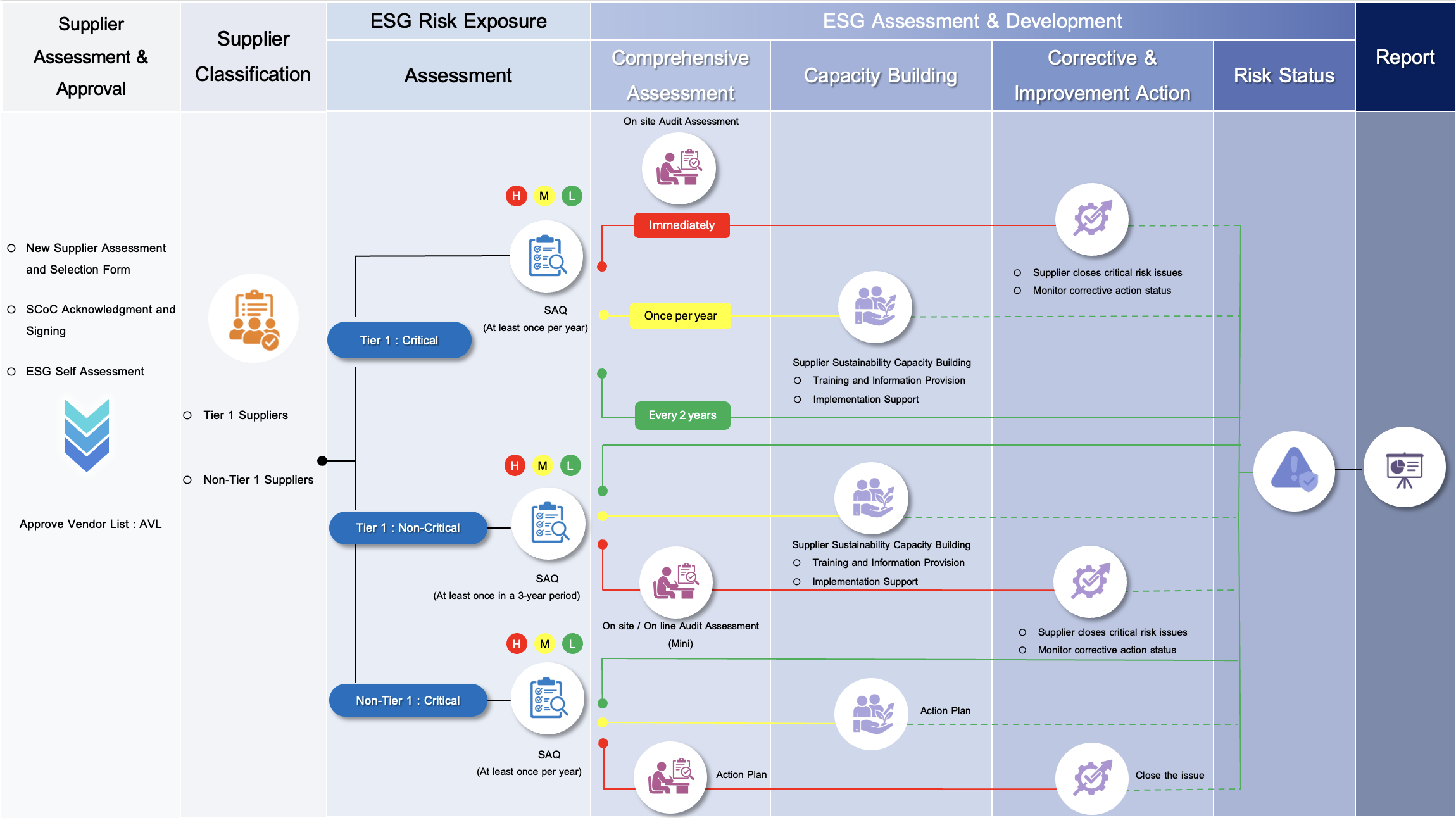
The Company’s supplier risk assessment consists of five processes, as follows:
1. Supplier assessment and approval
- New suppliers will be evaluated and selected through a screening process to ensure compliance with the Company’s requirements in terms of quality, pricing, and applicable standards.
- Both new suppliers and existing suppliers are required to acknowledge and sign the Supplier Code of Conduct and complete an ESG self-assessment covering the following four pillars:
- Environment
- Human Rights and Labor standard
- Health and Safety
- Business Ethics
- Suppliers that meet the established criteria will be included in the Approved Vendor List (AVL).
2. Supplier classification
Suppliers will be classified into three groups based on the supplier classification criteria set out in the classification table, considering supplier criticality (Critical / Non‑critical) and supplier tier (Tier 1 / Non‑Tier 1), as follows:
3. ESG risk exposure assessment
The Company conducts ESG risk exposure assessments for suppliers according to their classification, business criticality, and potential sustainability risk exposure. The frequency of assessment is determined based on supplier criticality, as follows:
- Critical Tier 1 Suppliers are required to complete a Self-Assessment Questionnaire (SAQ) at least once per year.
- Non-critical Tier 1 Suppliers: Suppliers are required to complete a Self-assessment Questionnaire (SAQ) at least once every three years.
- Critical Non-tier 1 Suppliers: Suppliers are required to complete a Self-assessment Questionnaire (SAQ) at least once per year.
NEO has established a process to evaluate, monitor and manage the sustainability performance of its suppliers. The evaluation may include as appropriate, on-site physical inspection audits to verify compliance with environmental, social, and governance requirements. The evaluation also includes online audits to validate ESG information provided by suppliers through assessments, questionnaires, or supporting documents.
The ESG risk exposure identified through the assessment process is classified into three levels:
- High
- Medium
- Low
Each risk level, across each supplier group, is subject to different monitoring, follow-up, and mitigation approaches as determined by the Company. This enables NEO to prioritize supplier engagement, address identified risks, and promote continuous improvement in sustainability performance throughout its supply chain.
4. Supplier monitoring and development
Following the supplier risk assessment and classification process, the Company implements supplier monitoring and development activities to manage ESG risks and support continuous improvement. This process consists of three key components, as outlined below:
4.1 Comprehensive Assessment
The scope and depth of assessments are determined based on the supplier’s risk level and supplier classification identified in the previous assessment stages. Comprehensive assessments include the following activities:
- On‑site audit assessments, including physical inspections of supplier operations or facilities
- Online or remote audit assessments, including document reviews and virtual interviews, where applicable
- Development and implementation of corrective or improvement action plans to address identified gaps or areas for improvement
These assessments are conducted to verify suppliers’ compliance with the Company’s ESG requirements, Supplier Code of Conduct, applicable laws and regulations, and relevant sustainability expectations.
4.2 Capacity Building
The Company supports suppliers in strengthening their sustainability capabilities through a range of capacity‑building initiatives, including:
- Training programs on relevant ESG topics, such as business ethics, human rights, labor practices, occupational health and safety, environmental management, and anti-corruption
- Knowledge-sharing, communication initiatives and practices to promote ESG awareness, responsible business practices, and effective sustainability management
- Guidance and support for integrating sustainability practices into suppliers’ day-to-day operations
- Participation in in‑depth technical support or development projects, where appropriate, to address specific ESG risks or improvement areas
These initiatives aim to enhance suppliers’ understanding and capability, while supporting continuous improvement and long‑term ESG performance.
4.3 Corrective and Improvement Actions
Suppliers identified as having high ESG risk are required to address and resolve significant risk issues within timelines defined by the Company. Corrective and improvement actions are implemented to ensure that identified gaps, non-compliance issues, or areas for improvement are properly managed and remediated. During the remediation period, the Company undertakes the following actions:
- Ongoing monitoring and follow-up on the implementation progress of corrective actions
- Provision of necessary support and guidance to help suppliers address identified issues and improve their sustainability performance
In case the suppliers are unable to resolve identified risk issues within the specified timeline, the Company may consider appropriate actions, including additional remedial measures.
5. Reporting and Disclosure
The Company discloses the results of supplier ESG risk assessments and management activities through appropriate communication channels, such as:
- The Company’s 56-1 one report (Annual Report)
- The Company website or other sustainability related publications
1. Buyer training
To strengthen internal capabilities in sustainable procurement, the Company provides structured training programs for employees, particularly those involved in procurement functions. These initiatives aim to enhance understanding of procurement policies, sustainability requirements, and responsible supply chain practices. The key training programs are as follows:
-
Procurement policy and sustainable supply chain practices
Target 2026 Performance 100% of procurement personnels received training 17 procurement personnels (100%) received training The Company conducts a dedicated training program for procurement personnel to strengthen their understanding of procurement policies and sustainable supply chain practices. This program also covers supplier sustainability risk assessment, enabling employees to identify, evaluate, and manage ESG-related risks within the supply chain. Furthermore, the training equips employees with the necessary knowledge and tools to support and enhance supplier capabilities, including building awareness and guiding suppliers toward improved environmental and social performance, particularly in preparation for achieving Green Industry Level 2 (Green Activity) certification.
-
SMETA 7.0 requirement training
NEO arranged a “SMETA 7.0 Requirement” training program delivered by PVI Consultant Co., Ltd., to enhance its understanding of SMETA (Sedex Members Ethical Trade Audit) requirements and audit processes. The program was designed to deepen employees’ understanding of SMETA (Sedex Members Ethical Trade Audit) requirements and audit processes.
Through this initiative, participants gained practical knowledge in key areas such as labor standards, occupational health and safety, environmental practices, and business ethics. This enables employees to more effectively assess supplier compliance, manage supplier audits, and ensure alignment with internationally recognized ethical trade standards.
In 2025, a total of 26 representatives from the following departments participated in the training program:
- Procurement
- Packaging Development
- Environmental Social & Corporate Governance
- Human Resource
- Safety
- Engineering
- Quality Management
2. Supplier Training and Capacity Building
Recognizing that supplier capability is essential to achieving sustainable outcomes, the Company actively supports its suppliers through training and continuous engagement. These efforts aim to strengthen suppliers’ understanding of the Supplier Code of Conduct, ESG expectations, and responsible business practices, while aligning their operations with the Company’s sustainability standards.
Beyond general awareness, the Company implements targeted capacity-building activities, including practical guidance and the sharing of best practices. Where appropriate, ongoing mentorship and support are provided to help suppliers address specific challenges and continuously improve their ESG performance.
-
Green Industry Level 5 (Green Network)
Having achieved Green Industry Level 5 (Green Network), NEO demonstrates its capability in extending environmental management across its entire supply chain. Building on this achievement, the Company actively drives Green Procurement through knowledge sharing and close collaboration with suppliers, encouraging alignment with the principles and guidelines of the Green Industry framework of the Ministry of Industry.
In 2025, NEO organized structured supplier training programs to translate this commitment into practical implementation. The training covered key topics such as Green Industry Level 2 (GI2) requirements and implementation guidelines, environmental policy development, environmental action planning, and operational practices including waste segregation and resource efficiency. The training also emphasizes the requirement for suppliers to implement environmental action plans and actively manage their environmental impacts through both reporting and impact reduction. Suppliers are encouraged to report relevant environmental performance data and demonstrate measurable outcomes from their initiatives, such as reductions in resource consumption, cost savings achieved and decreases in greenhouse gas emissions. Clear timelines and follow-up mechanisms were also established to ensure that suppliers could effectively apply the knowledge in their operations.
The Company further reinforces its commitment by providing hands-on support throughout the process. This includes structured training, practical tools and templates, and a mentorship program with periodic follow-ups to monitor progress and address challenges, supporting suppliers from initial preparation through to successful GI2 certification. The benefits of GI2 certification span across economic, environmental, and social dimensions. Economically, green practices create new business opportunities, enable expansion into growing green markets, and enhance corporate image, attracting customers, partners, and investors. Environmentally, efficient use of materials and energy reduces pollution and promotes resource conservation through recycling and reduces reliance on natural resources. Socially, improved environmental performance contributes to better public health and supports community development. Collectively, these outcomes strengthen a resilient and competitive green supply chain network while enabling long-term sustainable growth across the value chain.

Target 2025 Performance 100% of high impact suppliers participated in Green Industry 2 training and capacity‑building programs. 14 suppliers (100% of high impact suppliers) participated in Green Industry 2 training and capacity‑building programs. 100% of suppliers who participated in the training and capacitybuilding program were successfully certified under Green Industry Level 2 (GI2) or higher. 14 suppliers (100% of suppliers who participated in the training and capacitybuilding program) were successfully certified under Green Industry Level 2 (GI2) or higher. 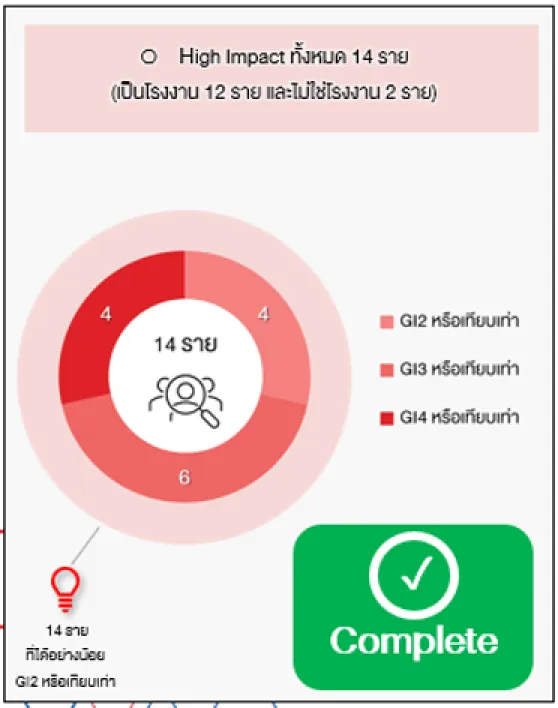
-
Strengthening Supplier Practices on Occupational Health and Safety (OHS)
In addition to environmental capacity building, NEO also places importance on the social dimension of its supply chain through supplier training on social issues, particularly in relation to occupational health and safety (OHS), by providing training for contractors, and sub-contractors who need to work within the company premises.
The training for suppliers and contractors is designed to strengthen their understanding of general OHS rules and regulations, requirements for entering production areas, and essential safety measures. These measures include the proper use of personal protective equipment (PPE) in high-risk areas, compliance with safety protocols, emergency evacuation procedures, and communication channels in case of emergencies. The program also requires participant to acknowledge the Company’s occupational health and safety policy, environmental policy, and proper waste segregation practices within the company premises. In addition, OHS training is provided to temporary visitors through recorded video materials to ensure awareness of key safety requirements prior to entering relevant areas.
In 2025, a total of 1,901 visitors, contractors, and sub-contractors participated in these training programs.
3. Involvement in sustainable supply chain management initiatives
The Company actively participates in and supports various sustainable supply chain management initiatives to strengthen its ESG performance and promote responsible business practices across its value chain. Through collaboration with business partners, suppliers, industry platforms, certification bodies, and relevant stakeholders, the Company seeks to align with recognized standards, enhance transparency, and drive continuous improvement in sustainability practices.
-
Partnership to Reduce Supply Chain Carbon Footprint through Sustainable Packaging (NEO x SCGP)
NEO collaborates with SCG Packaging Public Company Limited (SCGP) to adopt low-carbon corrugated packaging for key products. This initiative supports carbon footprint reduction across the value chain, enhances Scope 3 emissions management, and aligns with the Company’s Net Zero 2050 commitment, while ensuring transparency through Carbon Footprint Product (CFP) certification.
For further information, please refer to the Company’s News section on “NEO and SCGP Partner to Reduce Carbon Footprint through Eco-Friendly Packaging.”
Supplier Code of Conduct Acknowledgement
The Company sets a performance objective to ensure that its suppliers formally acknowledge and comply with the Supplier Code of Conduct. All existing and new suppliers are encouraged to sign and adhere to the Supplier Code of Conduct as a demonstration of their commitment to ethical business practices, compliance with laws and regulations, and alignment with the Company’s environmental, social, and governance (ESG) principles.
Where a violation of the Supplier Code of Conduct is identified, NEO will take actions in accordance with the severity of the non-compliance, ranging from notification and request for a Corrective Action Plan (CAP) for minor or low-risk cases, stop making transaction for moderate risk, discontinue business relationship for high risk, and termination of the business relationship for critical or zero-tolerance cases.
| Target | 2025 Performance |
|---|---|
| 100% of total suppliers acknowledge the Supplier Code of Conduct in 2030. | 217 (100% of total suppliers) acknowledge the Supplier Code of Conduct. |
Supplier Risk Assessment
| 2025 Performance | Target | |
|---|---|---|
| Total Suppliers | 217 | |
| Number of Suppliers Assessed | 217 | 80% of suppliers to be assessed in 2026 and 100% in 2027. |
|
- Potential new suppliers
|
TBC | |
|
- Existing suppliers
|
217 | |
| Suppliers identified as High ESG Risk | Pending | |
| Suppliers assessed through physical inspection audits | Pending | |
| Suppliers found noncompliant with the Supplier Code of Conduct (SCoC) | Pending | |
|
- Suppliers under monitoring with agreement on corrective action plan.
|
Pending | |
| Suppliers terminated due to noncompliance with SCoC | Pending |
Findings from suppliers monitoring and action taken
From the supplier monitoring and risk assessment process, 14 high-risk suppliers were identified based on ESG risk criteria, covering environmental management-related risks. Key issues identified include the absence of formal environmental policies and environmental management plans among certain suppliers.
NEO has communicated the identified ESG risks to the respective suppliers and required improvement actions and environmental management plans to address these gaps. The Company provides guidance and capacity-building support and conducts regular follow-ups and monitoring to ensure effective implementation.
NEO found in its assessment that two suppliers had yet to develop environmental policies and environmental management plans. Since the Company also recognized the need to provide recommendations and practical advice to establish the environmental management practices that were needed, Thus, both suppliers passed the improvement process and received Green Industry Level 2 (GI2) certification, which was awarded by the Department of Industrial Works.
Progress is monitored periodically, and suppliers are expected to achieve continuous improvement and compliance with the Company’s ESG expectations within the agreed timeline.
Future Improvement Plans
The Company has established plans to further enhance sustainable supply chain performance, as outlined below:
1. Responsible Sourcing and Sustainable Palm Oil Support
To promote responsible sourcing, NEO has established and integrated its Procurement Policy into procurement processes, ensuring that environmental considerations are appropriately addressed.
The Company is dedicated to using eco-friendly products, including sustainably sourced palm oil and RSPO-certified materials, while also encouraging suppliers to adopt sustainable sourcing practices. The RSPO portfolio is reviewed on a quarterly basis, with a commitment to increasing the proportion of certified materials beyond the current level of 0.5–0.9%.
Furthermore, the Company places importance on sustainable and environmentally friendly sourcing practices. The procurement team plays a key role in supporting research and development (R&D), as well as in the selection and procurement of environmentally products.
In addition, the Company encourages the development of clean products comprising continuous engagement with suppliers and moves towards using more eco-friendly materials throughout the value chain.
2. Participation in Supply Chain‑Related Initiatives
The Company has successfully achieved Green Industry Level 5 (Green Network) certification from the Ministry of Industry, reflecting its strong commitment to sustainable supply chain management and environmental responsibility.
Building on this achievement, the Company is reinforcing its commitment to sustainable supply chain practices by aiming to participate in internationally recognized initiatives such as Sedex. In particular, the Company plans to pursue Sedex membership by 2030 and is currently in the preparation phase to support this objective.
Through participation in such initiatives, the Company expects to engage more actively in industry platforms, capacity-building workshops, and collaborative programs. These efforts will contribute to enhancing ESG practices, improving supply chain transparency, and driving continuous improvement toward responsible and sustainable sourcing.