Pollution and resources are key factors affecting NEO’s business operations in relation to operating costs, regulatory compliance, and stakeholder confidence. Effective management can create positive impacts by reducing resource consumption, improving operational efficiency, and strengthening the company’s reputation.
At the same time, inadequate pollution and resource control may expose the company to legal, financial, and reputational risks. Changes in regulations and resource constraints present both challenges and opportunities for NEO to develop innovations and adopt more sustainable operating practices, which directly contribute to the company’s competitiveness and long-term growth.

NEO recognizes the importance of effective pollution and resource management and has established an Environmental and Climate Policy to ensure efficient operations. These policies serve as a framework for reducing environmental impacts, including air pollution control, waste management, and the efficient use of resources, in compliance with applicable laws, national development guidelines, and international standards (Environmental Management System: EMS) such as ISO 14001:2015.
The company also maintains Green Factory standards and has set a long-term goal for achieving Zero Waste to Landfill. NEO is committed to managing air pollution and acknowledges its impacts on the quality of life for all stakeholders, both internal and external. In this regard, the company monitors its air pollution and waste generation on an annual basis, with strict adherence to regulatory requirements. In addition, the company emphasizes efficient resource management by tracking resource consumption throughout the production process and setting targets to reduce waste emissions.
In 2025, NEO obtained ISO 14001 certification (Environmental Management System: EMS) and continues to maintain the certification, covering 100% of its manufacturing operations. NEO was not subjected to any environmental fines or penalties.
For further information, please refer to the Environmental and Climate Policy
NEO integrates circular economy principles across its operations to enhance resource efficiency, minimize waste generation, and promote reuse, recycling, and value creation throughout the value chain. This approach also extends to the development of sustainable products and packaging, with a focus on optimizing material use, increasing recyclability, and minimizing environmental impact while maintaining product quality and functionality.
-
Waste and Waste Management Approach
NEO understands that responsible waste management is a key environmental development need and a critical aspect of sustainability in its business operations. The systematic waste management approach of the Company is directed towards minimizing waste generation and reducing material impact on the environment, based on circular economy principles defined under the 3Rs (Reduce, Reuse, Recycle). This encourages resource efficiency, a cycle of constant operational improvement, and overall environmental performance sustainability.
NEO practices waste segregation, collection, recycling, recovery, treatment, and disposal in all of its operations in accordance with applicable laws and international standards (ISO 14001:2015). Data on waste produced from operations is monitored and analyzed regularly to find ways of reducing waste, increasing resource efficiency, and ensuring maximum recycling while diverting waste away from landfill sites.
The Company also partners with waste processors and service providers to encourage responsible processing and recycling. NEO continues to uncover innovative waste valorization, resource recovery, and clean technology solutions in support of its long-term sustainability strategy, while advancing its commitment towards the Zero Waste to Landfill goal.
Furthermore, NEO fosters staff awareness and involvement via internal communications and engagement activities that promote proper resource use and waste segregation. This encourages greater sustainable value creation for all stakeholders across the value chain by mitigating environmental footprints and enhancing resource efficiency.

-
Air Pollution Management Approach
NEO recognizes the importance of effective air pollution management as part of its commitment to environmental responsibility and sustainable operations. The Company is committed to preventing and reducing air emissions from manufacturing activities through systematic environmental management, operational improvement, and compliance with applicable laws and international standards, including ISO 14001:2015.
NEO continuously monitors and controls key air pollutants generated from operations, such as dust and smoke, through regular equipment maintenance, process efficiency improvement, and the implementation of appropriate pollution control technologies. The Company also conducts regular environmental monitoring and inspections to ensure compliance with legal requirements and minimize environmental impacts.
In addition, NEO promotes employee awareness and supports continuous improvement in environmental management practices to enhance operational efficiency, reduce environmental impacts, and contribute to sustainable growth alongside society and the environment.
The Use of Life Cycle Assessment (LCA) in Product Development
In order to minimize environmental impacts across all business processes, NEO adopted the LCA principle across business operation processes, from research and development, raw material sourcing, and production, to product distribution, while adopting international standards to support sustainable performance.
| 1: Raw Material Sourcing | |
| Design and product development |
|
| Raw material sourcing (Procurement process) |
|
| 2: Manufacturing Process | |
| Improve production efficiency |
|
| Modification of the Production Process |
|
| Reduce waste from production |
|
| Enhance workforce capability |
|
NEO also applied Life Cycle Assessment (LCA) to evaluate the carbon footprint of its products, based on the Carbon Footprint for Product (CFP) framework of the Thailand Greenhouse Gas Management Organization (TGO). This approach supports operational improvement and planning across the supply chain through the design and development of low-carbon products, and prepares for CFP certification for 2 product categories in the future, selecting the best-selling representatives from household products and personal care products.
Sustainable products and packaging
NEO remains committed to its SustainNEOvation approach, which focuses on improving consumers’ quality of life while capturing climate-related opportunities through products developed under the principle of “Responsibility.” This responsibility begins with the careful selection of raw materials, the development of environmentally friendly formulations, and the design of products and packaging that reduce environmental impacts across the value chain.
As part of its product development approach, NEO conducts research and development on materials used in both products and packaging to ensure that they continue to fulfill their intended functions while minimizing resource consumption. In 2025, the Company launched sustainable products through concepts below.
| Concepts | Description | Product highlights |
|---|---|---|
| 1. Responsible sourcing | Selecting materials with lower greenhouse gas emissions, replacing existing materials with lower-impact alternatives, using biodegradable materials, natural and organic ingredients, and prioritizing local sourcing where possible |
|
| 2. Enable recycling | Developing packaging solutions that reduce plastic consumption, improving recyclability the recycling and supporting reuse of plastic packaging materials. |
|
| 3. Increased lifecycle | Designing solutions that are durable, resource-efficient, and suitable for extended use. |
|
NEO recognizes sustainable products and packaging as climate-related opportunities, particularly in the area of green products, which are projected to account approximately 53% of the company’s revenue by 2025.
To achieve its long-term commitment, NEO has established the Sustainable Formulation Roadmap, aiming to reduce the use of following raw materials by 2030.
| Raw material | Target |
|---|---|
| Fabric Softener | Achieve 100% use of biodegradable softening agents across all fabric softener products. |
| Cologne | Achieve 100% elimination of Benzophenone-3 (a UV-filtering chemical) across all cologne products. |
| Liquid Soap | Achieve 100% SLES-free formulations across all liquid soap products. |
| Detergent | 85% of all detergent formulations are biodegradable. |
Stakeholder Engagement
NEO is committed to strengthening partnerships with both the public and private sectors through participation in local initiatives, namely Thailand Institute of Packaging and Recycling Management for Sustainable Environment (TIPMSE) under The Federation of Thai Industries (F.T.I.). These efforts aim to promote knowledge sharing, enhance collaboration, and support the development of policies and regulatory frameworks with other large organizations to reduce pollution, waste and resource use under the Extended Producer Responsibility principle at the national level.
These partnerships support NEO’s efforts to achieve Zero Waste to Landfill targets, while improving management systems to align with long-term sustainable development goals. Currently, NEO is involved in the following collaborative initiatives:
| Partnership | Topic for Engagement | Position and Activities |
|---|---|---|
| PackBack by TIPMSE | NEO participated as a member of the PackBack initiative, a packaging take-back initiative based on circular economy principles under Extended Producer Responsibility (EPR) |
|
For further information about the activities and members, please refer to the TIPMSE website
Quantitative Performance
Air Pollution Reduction Targets
The company actively mitigates air pollution risks arising from its production processes, including fuel combustion in boilers and the use of chemicals in manufacturing operations. Hence, NEO has established air emission management targets, covering all operations and conducts regular air emission monitoring on an annual basis to ensure that air pollution levels comply with legal requirements. The Company also continuously improves operational efficiency and promotes cleaner fuel utilization to minimize environmental impacts from air emissions.
| Target | Type of Pollution | Timeframe | % achievement against target |
|---|---|---|---|
| Ensure 100% compliance with applicable air emission regulations across all operations | SO2, NOx, TSP, CO | Annual | 100% |
Waste Reduction Targets
NEO is committed to managing waste efficiently through the principles of reduction (Reduce), reuse (Reuse), and recycling (Recycle) for waste at all stages of its business activities. The objective is to enhance the efficient use of resources, covering all operations. Therefore, NEO has set targets to reduce the amount of waste disposed of by landfill. NEO intends to continuously minimize or eliminate the amount of waste sent to landfill (Zero Waste to Landfill) in the future.
ของเสียจากกระบวนการผลิตเปรียบเทียบยอดขาย (2566-2568)
| ของเสียจากกระบวนการผลิตเปรียบเทียบยอดขาย (ร้อยละ) | |||
|---|---|---|---|
| 2566 | 2567 | 2568 | |
| เป้าหมาย | 0.002 | 0.00181 | 0.00167 |
| ผลที่เกิดขึ้นจริง | 0.001 | 0.00085 | 0.00226 |
| Target | Timeframe | % achievement against target |
|---|---|---|
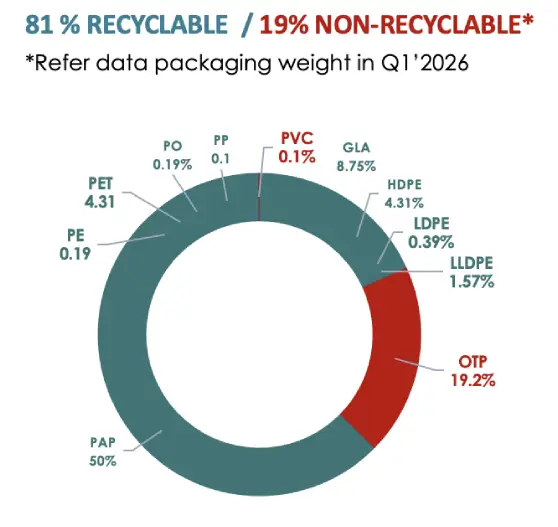
| Achieve 100% recyclability of packaging by 2030. | 2030 | 81% |
| Increase the use of recycled materials by 10%. | 2030 | 4.7% |
Raw Materials and Packaging Reduction Targets
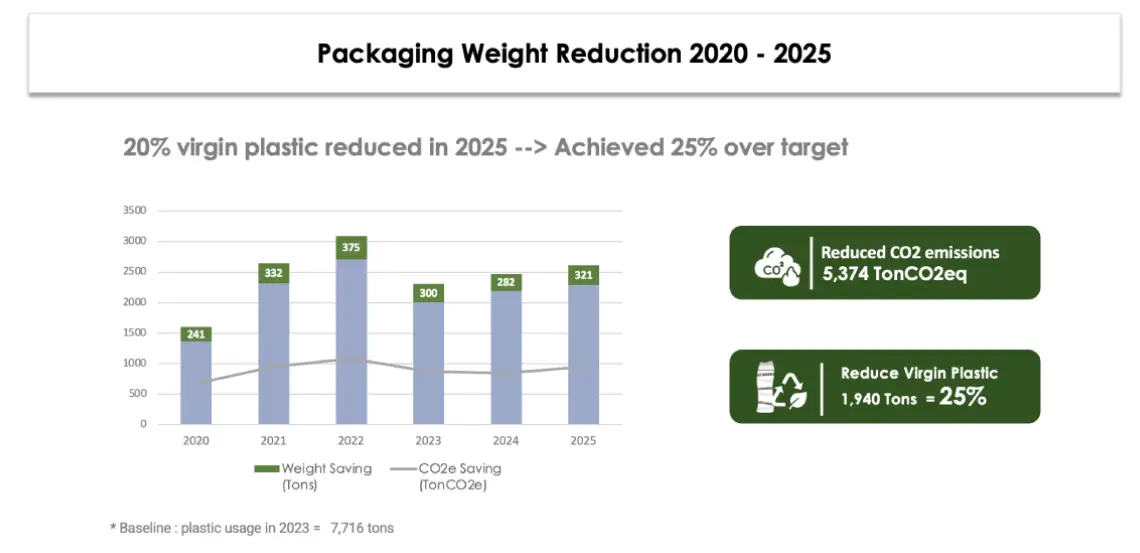
In addition to fulfill commitment to efficient resource utilization, NEO has established targets to reduce raw material consumption as follows:

Air Pollution Performance
| Air Pollution | ||||
|---|---|---|---|---|
| Indicator | Unit | 2023 | 2024 | 2025 |
| Total air pollution | tonnes | 12.89 | 6.55 | 1.50 |
| SO2 | tonnes | 10.42 | 4.27 | 0.25 |
| NOx | tonnes | 2.47 | 2.28 | 1.25 |
In 2025, NOx emissions decreased to 1.03 tonnes or 45%, compared with 2.28 tonnes in 2024
in 2025, SOx emissions decreased to 4.02 tonnes or 94%, compared with 0.25 tonnes in 2024
Waste Generated Performance
| Waste Generated | ||||
|---|---|---|---|---|
| Indicator | Unit | 2023 | 2024 | 2025 |
| Total waste generated | tonnes | 2,253.32 | 4,766.36 | 3,999.40 |
| Total hazardous waste generated | tonnes | 1,503.37 | 1,275.73 | 869.48 |
| Total non-hazardous waste generated | tonnes | 749.95 | 3,490.63 | 3,129.92 |
| Total waste diverted from disposal | tonnes | 2,105.35 | 3,562.61 | 2,677.20 |
| Total hazardous waste diverted from disposal (onsite) | tonnes | - | - | - |
| • Preparation for reuse | tonnes | - | - | - |
| • Recycling | tonnes | - | - | - |
| • Other recovery operations | tonnes | - | - | - |
| Total non-hazardous waste diverted from disposal (onsite) | tonnes | - | - | - |
| • Preparation for reuse | tonnes | - | - | - |
| • Recycling | tonnes | - | - | - |
| • Other recovery operations | tonnes | - | - | - |
| Total hazardous waste diverted from disposal (Offsite) | tonnes | 1,475.50 | 1,223.89 | 745.55 |
| • Preparation for reuse | tonnes | 266.73 | 371.86 | 371.87 |
| • Recycling | tonnes | - | - | - |
| • Other recovery operations | tonnes | 1,208.77 | 852.03 | 373.68 |
| • Unknown disposal method | tonnes | - | - | - |
| Total non-hazardous waste diverted from disposal (Offsite) | tonnes | 629.85 | 2,338.72 | 1,931.65 |
| • Preparation for reuse | tonnes | - | - | - |
| • Recycling | tonnes | 299.87 | 705.09 | 1,653.61 |
| • Other recovery operations | tonnes | 329.98 | 1,633.64 | 278.04 |
| • Unknown disposal method | tonnes | - | - | - |
| Total waste directed to disposal | tonnes | 147.97 | 1,203.75 | 1,322.20 |
| Total hazardous waste directed to disposal (onsite) | tonnes | - | - | - |
| • Incineration (with energy recovery) | tonnes | - | - | - |
| • Incineration (without energy recovery) | tonnes | - | - | - |
| • Landfilling | tonnes | - | - | - |
| • Other disposal operations | tonnes | - | - | - |
| • Unknown disposal method | tonnes | - | - | - |
| Total non-hazardous waste directed to disposal (onsite) | tonnes | - | - | - |
| • Incineration (with energy recovery) | tonnes | - | - | - |
| • Incineration (without energy recovery) | tonnes | - | - | - |
| • Landfilling | tonnes | - | - | - |
| • Other disposal operations | tonnes | - | - | - |
| • Unknown disposal method | tonnes | - | - | - |
| Total hazardous waste directed to disposal (Offsite) | tonnes | 27.87 | 51.84 | 123.93 |
| • Incineration (with energy recovery) | tonnes | 27.22 | 50.80 | 41.50 |
| • Incineration (without energy recovery) | tonnes | - | - | 82.43 |
| • Landfilling | tonnes | 0.65 | 1.04 | - |
| • Other disposal operations | tonnes | - | - | - |
| • Unknown disposal method | tonnes | - | - | - |
| Total non-hazardous waste directed to disposal (Offsite) | tonnes | 120.10 | 1,151.91 | 1,198.27 |
| • Incineration (with energy recovery) | tonnes | - | 71.92 | 154.03 |
| • Incineration (without energy recovery) | tonnes | 70.16 | 202.84 | - |
| • Landfilling | tonnes | 49.94 | - | - |
| • Other disposal operations | tonnes | - | 877.15 | 1,044.24 |
In 2025, total waste decreased to 766.96 tonnes or 16 %, compared with 4,766.36 tonnes in 2024
Raw Materials and Packaging Materials Performance
| Raw Materials and Packaging Materials | ||||
|---|---|---|---|---|
| Indicator | Unit | 2023 | 2024 | 2025 |
| Total Raw Materials and Packaging Materials | Tonnes | 55,444.98 | 62,884.53 | 67,119.27 |
| Raw Materials | Tonnes | 41,830.98 | 44,798.53 | 46,044.27 |
| Non-renewable | Tonnes | 41,666.98 | 44,687.53 | 45,828.27 |
| Renewable | Tonnes | 164.00 | 111.00 | 216.00 |
| Total Packaging Materials | Tonnes | 13,614 | 18,086 | 21,075 |
| PET (Polyethylene Terephthalate) | Tonnes | 683 | 875 | 1,037 |
| PE (Polyethylene) | Tonnes | 90 | 44 | 57 |
| PO (Polyolefin) | Tonnes | - | 3 | 14 |
| PS (Polystyrene) | Tonnes | - | - | - |
| PP (Polypropylene) | Tonnes | 1,065 | 1,199 | 1,340 |
| PVC (Polyvinyl Chloride) | Tonnes | 150 | 132 | 88 |
| LDPE (Low Density Polyethylene) | Tonnes | 50 | 66 | 79 |
| LLDPE (Linear Low Density Polyethylene) | Tonnes | 338 | 310 | 349 |
| HDPE (High-Density Polyethylene) | Tonnes | 2,743 | 2,263 | 1,915 |
| rHDPE (Recycled High-Density Polyethylene) | Tonnes | - | 379 | 606 |
| Laminates | Tonnes | 2,597 | 2,942 | 3,681 |
| Nonplastic | Tonnes | 5,898 | 9,873 | 11,909 |