
Climate change and Greenhouse Gas (GHG) emissions have significant implications for the company as well as the economy, environment, and society. Climate Change can escalate risks arising from climate variability, such as flooding, droughts, and extreme weather events, which may affect operating costs, resource availability, and business continuity.
However, the company can capture opportunities towards arising from the low carbon transition, including resource efficiency improvement and sustainable product development in order to meet stakeholder expectations and support long-term sustainable growth.

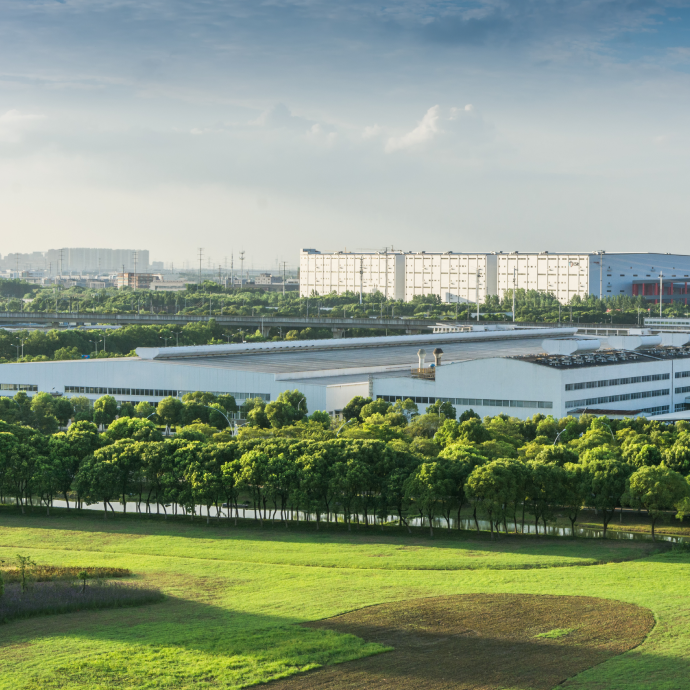
NEO recognizes the importance of climate change management. By this, NEO has adopted the Environmental and Climate Policy as operational framework and guideline, aiming for managing environmental impacts, addressing climate-related issues, achieving the goal of achieving net‑zero emissions by 2050. as well as improving energy efficiency at corporate level.
Our policies are developed in accordance with international standards and relevant local’s environmental law and regulations, as well as the Thailand’s aspiration - Nationally Determined Contributions (NDCs) and Thailand’s practices, namely Green Factory standards.
Furthermore, NEO places importance on transparent and internationally aligned climate-related disclosure. The company has adopted the recommendations of the Task Force on Climate-related Financial Disclosures (TCFD) as a guiding framework for managing climate-related risks and opportunities. Relevant information is disclosed through its annual report and corporate website to ensure that stakeholders have access to comprehensive information.
For further information, please refer to the Environmental and Climate Policy
In order to ensure that the management of environmental impacts and greenhouse gas emissions is conducted effectively, transparently, and in alignment with the established policies and targets, NEO has clearly defined the roles and responsibilities of the Board of Directors, management, and relevant departments to support strategic decision‑making and the systematic and continuous implementation of climate change‑related management.
| Role | Responsibility | Meeting Frequency |
|---|---|---|
| Chairman of the Board of Directors | Encourage the Company to operate in line with ESG principles and consider climate change issues in business decisions including oversee the disclosure of climate and sustainability information to ensure it is appropriate, transparent, and aligned with relevant standards. | 6 times per year |
| Sustainability Committee | Oversees the implementation of and provides guidance on the Company’s sustainability‑related activities, covering environmental, social, governance, and climate change dimensions. The Committee also supports and encourages the Board of Directors, management, and employees to act in accordance with the Company’s sustainable development guidelines. | 2 times per year |
| Audit Committee | Consider and establish guidelines for managing climate change‑related risks to help the Company adapt and grow sustainably with support the organization in managing risks and opportunities related to climate change. | 4 times per year |
NEO has defined corporate objectives for climate change mitigation, including GHG (tCO2e) and clean-energy targets. These corporate targets are incorporated into the operating planning of the Company and form part of the performance evaluation measures for employees throughout the organization, thereby promoting effective implementation of climate-related strategies and objectives.

NEO is committed to managing climate-related impacts, risks, and opportunities by integrating climate-related considerations into its corporate strategy. NEO climate management approach focuses on reducing GHG emissions, improving energy efficiency, increasing the use of renewable energy, enhancing resource efficiency, and engaging suppliers and business partners to reduce climate-related impacts across the value chain.
NEO Decarbonization Strategy
To support the achievement of its short, medium, and long-term greenhouse gas (GHG) reduction targets, NEO has developed a decarbonization strategy aimed at reducing GHG emissions 20% by 2030 and achieving net-zero emissions by 2050. The climate strategy outlines the key actions plan to meet these targets within the designated timeframe. The organization’s key actions to reduce GHG emissions are outlined below.
Scope 1:
- Cleaner fuel conversion, including switching from fuel oil to liquefied natural gas (LNG)
- Energy efficiency improvement initiatives such as energy optimization projects and implementation of energy management systems in order to reduce aggregated power consumption.
- Mobile fuel switching to clean energy, including the transition of company vehicles to Electric Vehicles (EVs) and other low-emission transportation alternatives. Stationary Fuel Switching to clean energy, such as feasibility study of boiler electrification and green hydrogen)
Scope 2:
- Installation of 2.8 MWP Solar PV by 2026
- Increasing the proportion of renewable electricity to 40% by 2030 and 100% by 2050
- Sourcing green electricity (such as RECs or I-RECs)
Scope 3:
- Development of sustainable packaging
- Increasing the use of low-carbon materials (such as low-carbon surfactants)
- Designing 100% recyclable packaging by 2030
- Improving logistics efficiency
- Sourcing local materials
- All paper packaging uses low-carbon materials
- Establishing circularity for plastic packaging through post-consumer recycled materials
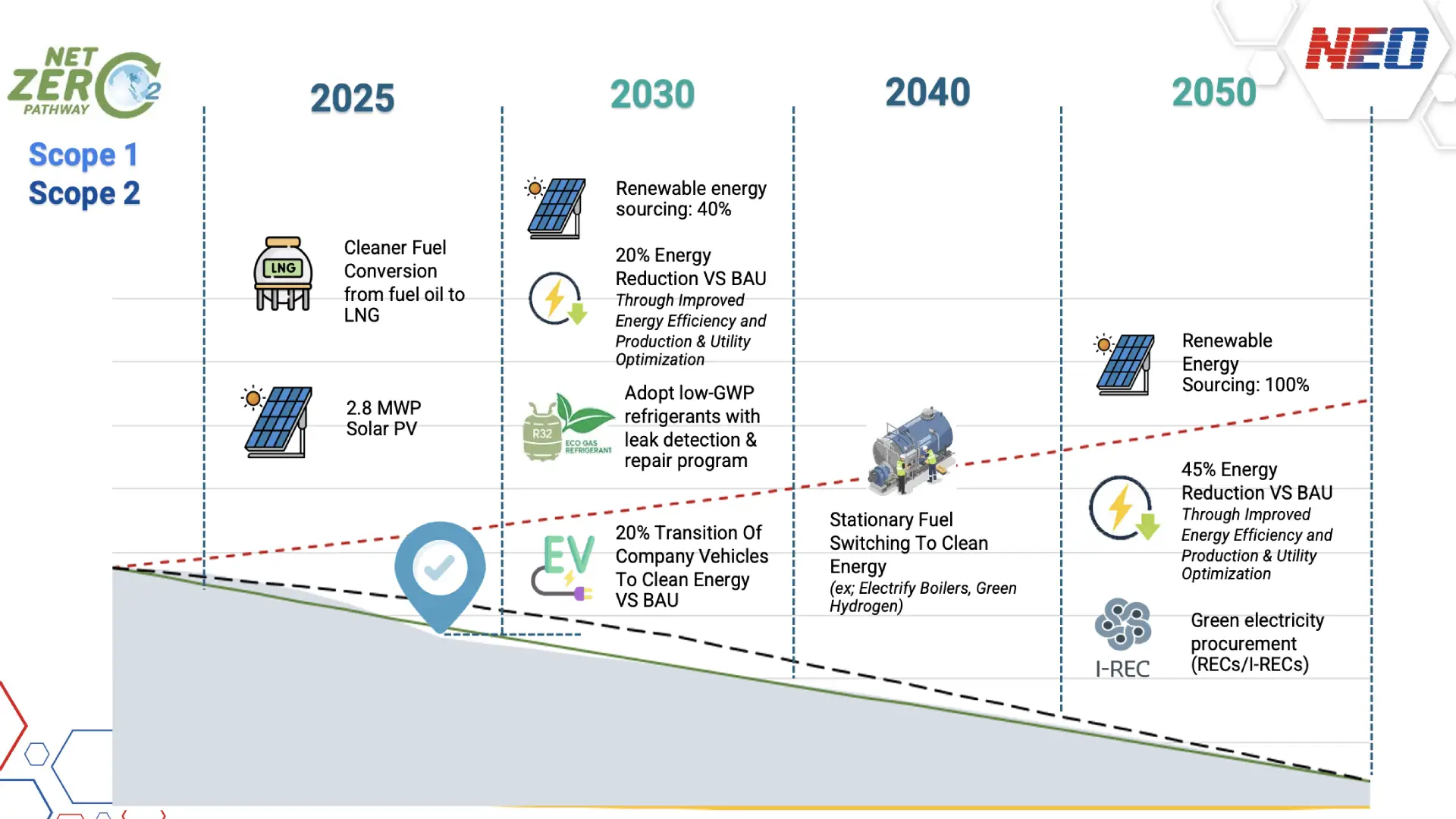
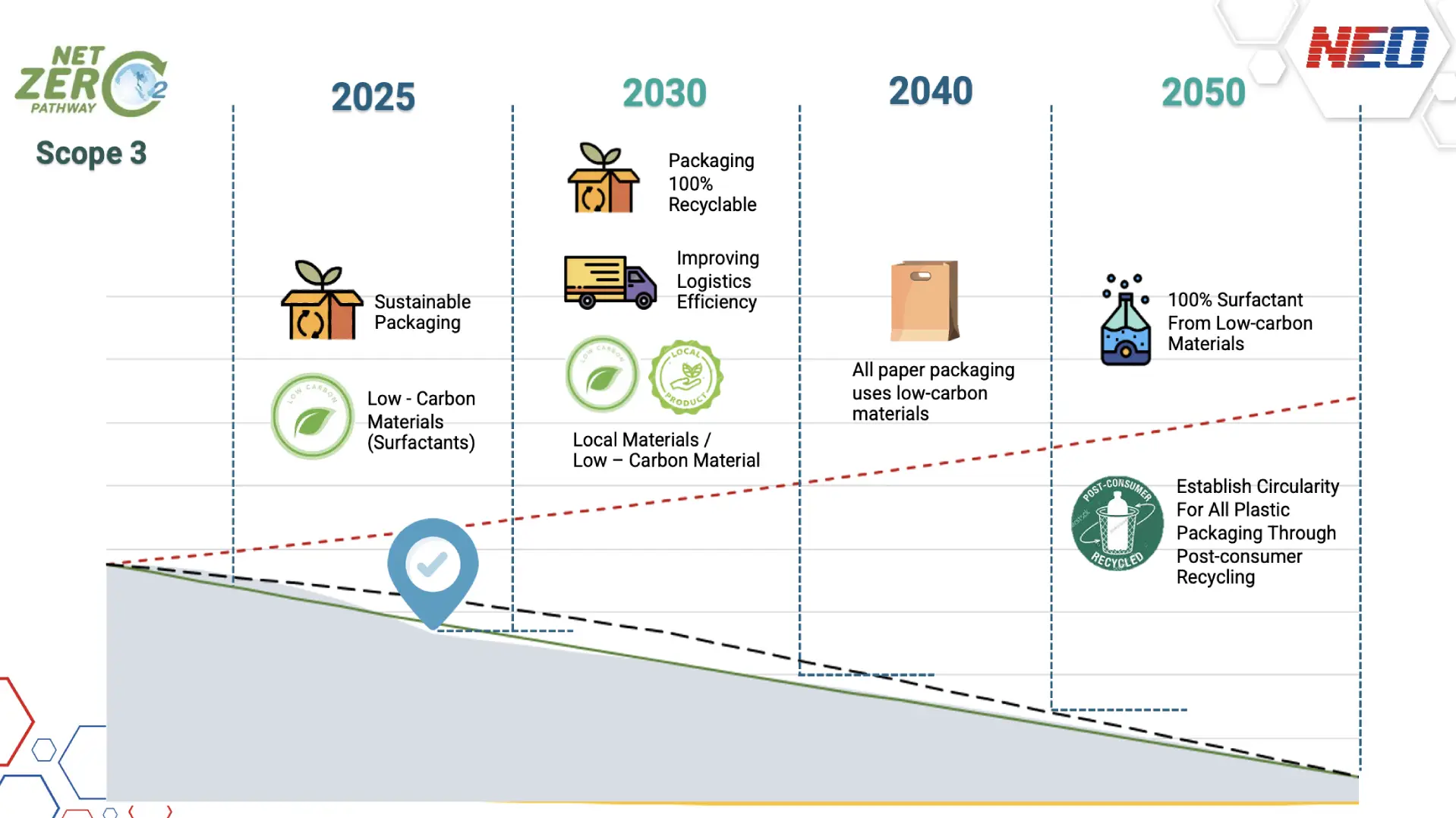
NEO is continuously taking action to reduce greenhouse gas emissions across Scope 1, Scope 2, and Scope 3. In 2025, the Company implemented several supporting projects to advance its emissions reduction efforts, including the improvement of transportation efficiency through an Automated Storage and Retrieval System (ASRS) conveyor system, the transition of the primary fuel source for boilers from fuel oil to liquefied natural gas (LNG), the installation of rooftop solar panels at its factory, and the optimization of production processes to enhance energy efficiency and reduce greenhouse gas emissions.
For further information, please refer to the One Report (Form 56-1) 2025.

NEO has identified, assessed, and integrated risks related to sustainable business development, including climate change–related risks, into its company‑wide risk management system. This is to ensure that the impacts of climate change are systematically considered, monitored, and managed within the enterprise risk management process, as well as to enhance stakeholder confidence and support the Company’s long‑term business growth.
To address the challenges arising from climate change, NEO has considered and assessed risks and opportunities that may affect its business operations in the short (1-3 years), medium (3-10 years), and long term (>10 years), covering physical risks associated with climate change, as well as opportunities to enhance operational efficiency, product development, and organizational adaptation, in order to strengthen the Company’s competitiveness and long‑term business sustainability.
NEO climate-related risk management process includes steps as follows:
- Risk identification covering physical risk: NEO recognizes and evaluates the potential impacts of climate-related physical risks to its operations, ranging from floods, extreme weather events, supply chain disruption to production facilities, warehouses, logistics and delivering product. Such assessment accounts impact on business operations & operational continuity in short-term, medium term and long-term perspective.
- Risk response and risk management planning: NEO implements mitigation measures and preparedness plans to reduce potential impacts from climate-related physical risks. Key measures include business continuity and emergency response planning, installation of emergency pumps and flood barriers, maintenance of drainage and water management systems, backup power systems, and operational preparedness to minimize potential business disruption.
- Risk monitoring and review: NEO is continuously tracking climate related physical risks with regular assessments on how the level of these risks may change, the effectiveness and efficiency of mitigation measures and operational readiness. The Company also continues to periodically review related risk indicators and mitigation actions necessary to ensure climate-related risks are being properly monitored and are in line with current business conditions and operational realities.
NEO recognizes that climate change may introduce significant uncertainty to business operations, supply chain continuity, asset resilience, and long-term value creation. Our climate-related risks include physical risks, such as acute and chronic changes in weather patterns, which may affect business operations, supply chain continuity, and operational resilience. NEO is currently in the process of developing a climate scenario analysis, which allows NEO to assess the potential impacts of climate-related scenarios on the Company’s business operations, financial planning, and risk management over short-, medium-, and long-term time horizons.
As part of the initial phase, NEO has conducted a preliminary physical climate risk assessment using the Aqueduct Water Risk Atlas, covering 100% of its operation sites, namely headquarters and NEO Factory. This tool is applied to evaluate location-specific exposure to water-related physical risks, including baseline water stress, flood risk, drought risk, seasonal variability, and other relevant water risk indicators.
The Company conducted a location-based water risk assessment covering key operational sites on an annual basis, including Neo Factory in Pathum Thani Province and Neo Corporate in Bangkok, using the AQUEDUCT Water Risk Atlas, an internationally recognized water risk assessment tool, to evaluate both current and future water-related risks.
The assessment covered multiple dimensions of physical water-related risks, including Water Stress, Seasonal Variability, Drought Risk, Riverine Flood Risk, and Coastal Flood Risk, which may potentially affect business continuity, water resource security, operational resilience, and the Company’s ability to adapt to climate change impacts. The results of the physical risk analyses are reported based on geographical locations as illustrated in the figure below;

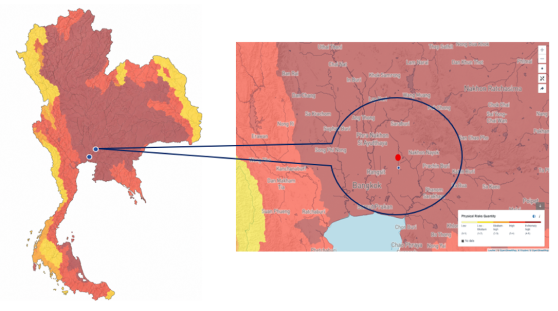
Neo Factory, located in Pathum Thani Province, is situated in an area identified as having extremely high physical water-related risks, particularly regarding water stress and riverine flood risk. These risks may potentially affect water availability for production processes and operational continuity during extreme weather events or prolonged drought conditions.
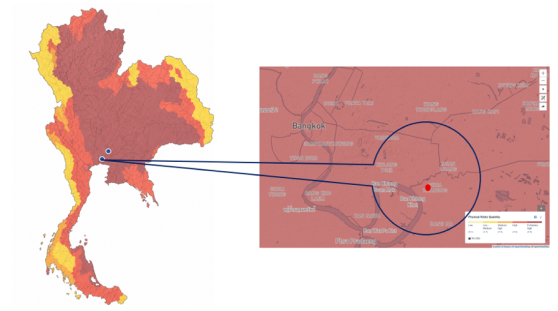
Neo Corporate, located in Bangkok, was also identified as being exposed to high physical water-related risks, including water stress, seasonal variability, and coastal flood risk associated with urban flooding and climate change impacts.
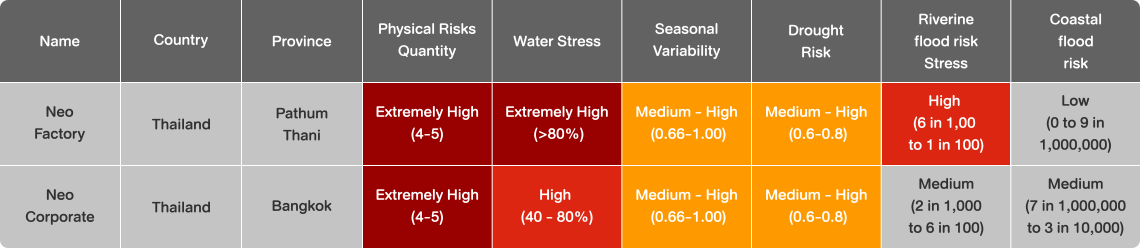
The assessment results indicated that both operational sites are in areas classified as having Extremely High Physical Risk Quantity exposure. At NEO Factory, the assessment identified high exposure to flood risk and medium-to-high exposure to seasonal variability, drought risk and riverine flood. Meanwhile, NEO Corporate was assessed as having medium-to-high exposure to physical climate-related risks.
To strengthen its ability to manage these risks, the Company has begun integrating climate-related risks into its Enterprise Risk Management (ERM) process. This integration enables climate-related issues to be systematically identified, assessed, monitored, and managed as part of the Company’s overall risk management framework.
Additionally, NEO is keen to monitor and develop mitigation and adaptation measures to strengthen the Company’s climate resilience and opportunities across operational sites. The assessment also considers potential impacts on the Company’s operations. The details of the NEO’s climate risk and opportunity management are provided below:
| Climate-related Risk | Timeframe | Potential Business Impact | Mitigation | Financial Implication (THB) |
|---|---|---|---|---|
| Flooding | 3 years onward |
|
|
Potential 1–3% revenue impact[1] |
| Extreme Heat | 3 years onward |
|
|
Potential 1–3% revenue impact[1] |
| Drought | 3 years onward |
|
|
Potential 1–3% revenue impact[1] |
| Climate-related Opportunity | Timeframe | Potential Business Impact | Adaptation Strategies | Financial Implication (THB) |
|---|---|---|---|---|
| Sourcing low-carbon footprint material | 3 years onward |
|
|
Potential 1–3% revenue impact [2] |
| Increased revenue from green product design | 3 years onward |
|
|
Potential 1–3% revenue impact [2] |
NEO is committed to aligning its future capital expenditures (CapEx) with the Company’s long‑term greenhouse gas emission reduction targets, including the goal of limiting global temperature rise to no more than 1.5°C in line with the Paris Agreement. The Company plans to invest approximately THB 58,393,597.81 million during the period 2018–2025 to support low‑carbon projects and technologies. NEO is progressively adjusting its investment portfolio to reduce reliance on carbon‑intensive assets and integrates greenhouse gas impact assessments into its investment decision‑making processes, to ensure that capital allocation is aligned with its greenhouse gas reduction plan and Net Zero Emission target by 2050.


NEO places importance on engaging with key stakeholder groups and conducts such engagement through appropriate channels and formats, such as communication, meetings, and feedback collection, to identify environmental and climate change–related issues. The feedback and suggestions received are analyzed and applied to continuously improve operations, policies, and processes, to ensure that business operations align with stakeholder expectations while strengthening long‑term business confidence.
Membership in Organizations Dedicated to Climate-Related Issues and Company Involvement
NEO is committed to building strong partnerships with both the public and private sectors through participation in public initiatives and engagement with trade associations. These efforts aim to facilitate knowledge exchange, foster collaboration, and support the development of policies and regulations that promote national-level greenhouse gas reduction.
Such collaborations strengthen NEO’s role in supporting the achievement of Net Zero Emissions targets, while simultaneously enhancing internal management systems and operational processes to align with long-term sustainable development goals. At present, NEO is actively involved in the following collaborative initiatives:
| Association Name | Topic for Engagement | Climate Policy Position and Activities |
|---|---|---|
| Thailand Carbon Capture, Utilization and Storage Alliance (Thailand CCUS Alliance: TCCA) | Participation in establishing a collaborative alliance and supporting the advancement of CCUS technology in Thailand |
|
| PackBack by TIPMSE | Participation as a member of the PackBack initiative, a packaging take-back initiative based on circular economy principles under Extended Producer Responsibility (EPR) |
|
| The Federation of Thai Industries (FTI) | Member of FTI |
|
Quantitative Performance
-
GHG Emission target
Net-Zero targets: Achieve net-zero emissions across Scope1, 2, and 3 by 2050
Near-term targets:
Scope of target Target Timeline Scope 1 and 2 emissions from our operations 20% reduction By 2030, against a 2023 baseline Scope 3 energy and industrial GHG emissions (from cat 1, 3, 4, 5 and 9) 20% reduction By 2030, against a 2023 baseline -
Energy consumption reduction target
Achieve 40% green energy usage by 2030
Quantitative Performance
*Remark: The Company’s greenhouse gas emissions are calculated in accordance with the requirements for carbon footprint calculation and reporting for organizations, Version 6 (July 2022), issued by the Thailand Greenhouse Gas Management Organization (Public Organization), and are aligned with the international standard ISO 14064-1. The assessment covers direct greenhouse gas emissions (Scope 1), indirect greenhouse gas emissions from energy consumption (Scope 2), and other indirect greenhouse gas emissions (Scope 3), including seven greenhouse gases: carbon dioxide (CO₂), methane (CH₄), nitrous oxide (N₂O), hydrofluorocarbons (HFCs), perfluorocarbons (PFCs), sulfur hexafluoride (SF₆), and nitrogen trifluoride (NF₃).Emission Scopes GHG Emissions (tCO2e) 2023 2024 2025 Target 2025 Total GHG Emissions (Scope 1+2+3) 199,382.00 218,726.00 174,929.00 Direct GHG Emissions (Scope 1) 4,953.00 4,877.00 4,098.00 Location-based energy indirect (Scope 2) 6,601.00 6,858.00 9,909.00 Market-based energy indirect (Scope 2) 6,601.00 6,858.00 9,909.00 Other relevant indirect GHG emission (Scope 3) 187,828.00 206,991.00 160,922.00 Category 1: Purchased goods and services (Raw material, Packaging, and Service) 180,162.16 196,507.97 152,385.21 Category 3: Fuel- and Energy-Related Activities (not included in Scope 1 or 2) 1,777.79 1,806.16 2,282.00 Category 4: Upstream Transportation and Distribution 534.57 599.00 597.15 Category 5: Waste Generated in Operations 1,233.39 4,138.65 1,303.36 Category 9: Downstream transportation and distribution 4,119.73 3,938.69 4,354.00 Scope 1 Scope 2 and Scope 3 Emission Intensity (tCO2e per production capacity) 1.0345 1.1142 0.8274
Exceeded the target0.9724 Performance 2023 2024 2025 Total electricity consumption (kWh) 14,786,478.28 15,539,090.38 23,383,965.34 Purchased electricity consumption (kWh) 13,203,719.18 13,717,808.00 20,859,125.50 Electricity consumption from purchased or self-generated renewable energy (kWh) 1,582,759.10 1,821,282.38 2,524,839.84 Data Verification and Assurance
NEO has prepared its Carbon Footprint of Organization (CFO) in accordance with the requirements of the Thailand Greenhouse Gas Management Organization (Public Organization) and in alignment with the international standard ISO 14064-1, covering greenhouse gas emissions under Scope 1, Scope 2, and Scope 3. The report has been verified by an independent third party, BSI Group (Thailand) Co., Ltd., at a limited assurance level with a materiality threshold of 5%, to enhance transparency and the credibility of the information disclosed to stakeholders.
For further information, please refer to the Data Verification and Assurance available at: